
South Korean, French Firms Win $400M Vietnam High-Speed Rail Study
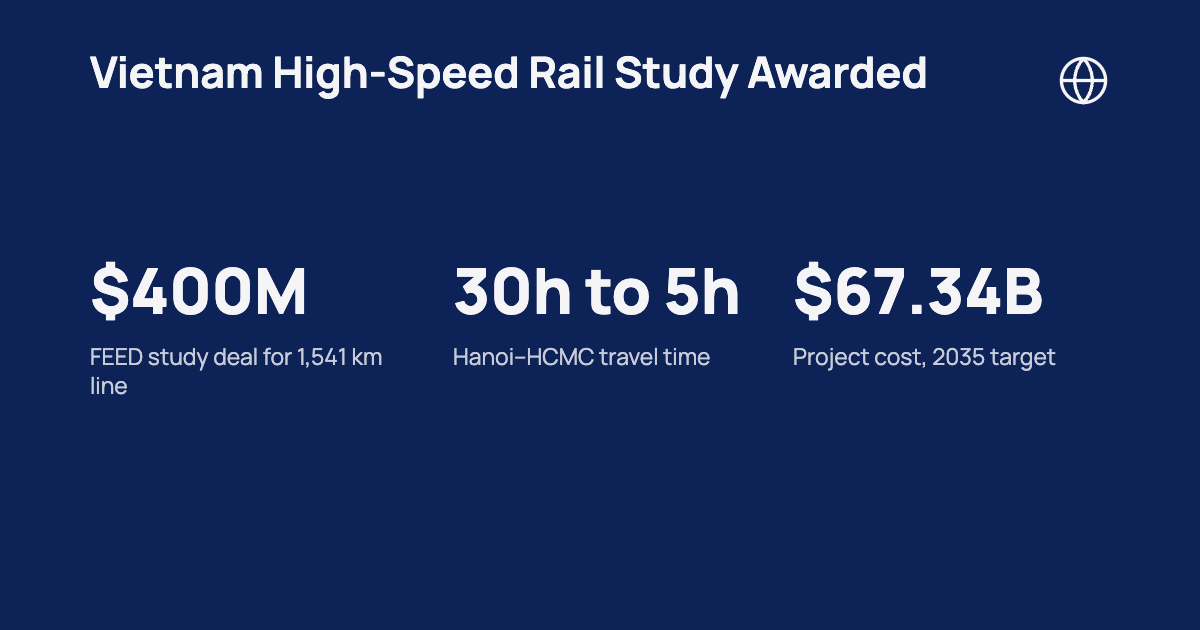
A consortium led by France's SYSTRA and South Korea's state-run Korea National Railway has won the feasibility study and front-end engineering design contract for Vietnam's planned North-South high-speed railway. The award, valued at about $400 million, was announced by South Korea's transport ministry on Nov. 22, 2026.
The eight-company group also includes South Korea's Sambo Engineering and Yooshin Engineering, and four Vietnamese firms led by Transport Engineering Design Inc. The 30-month consultancy package, estimated at 560 billion won ($397-416 million), is the largest overseas railway design deal won by a Korean-backed consortium, according to the Ministry of Land, Infrastructure and Transport.
This contract win was made possible by combining the capabilities of public institutions and private companies with the government's sustained efforts.
South Korean Transport Minister Hong Ji-seon, Nov. 22, 2026
The contract covers design for a 1,541 km double-track line on the 1,435 mm standard gauge, with a design speed of 350 km/h. The route will run from Ngoc Hoi Station in Hanoi to Thu Thiem Station in Ho Chi Minh City, crossing 15 provinces and serving 23 passenger stations and five freight stations. Vietnam's government has said the line will cut travel time between the two cities from about 30 hours by conventional rail to roughly five hours.
Project timetable
Under the work plan, the consortium will deliver an interim route and technology report within a year, allowing land clearance to begin in late 2027. Main construction is scheduled to start in 2029, with completion targeted for 2035. The total investment is estimated at $67.34 billion, making it Vietnam's largest single transport project.
Why it matters
The feasibility and design stage will help set technical standards for one of Southeast Asia's most closely watched infrastructure programs. It fixes route alignment, station layout and system specifications that will shape later procurement of signaling, track systems and rolling stock, work that could attract European and Asian manufacturers to Vietnam's high-speed rail supply chain.
For logistics in Vietnam, the line offers a potential shift away from road-dominated freight between the industrial north and the southern commercial hub. Rail corridors that can move cargo reliably at high speed would relieve pressure on congested highways and port access roads, lowering distribution costs for manufacturers in a country that has become a major export base. The project also matters to international trade finance: a program of this size is likely to involve multi-year lending commitments, guarantees, cross-border payments and currency management, making its procurement model relevant well beyond the rail sector.
Subscribe
Get Niien News updates in your inbox.