
The Hidden Cost of AI-Generated Code: Comprehension Debt
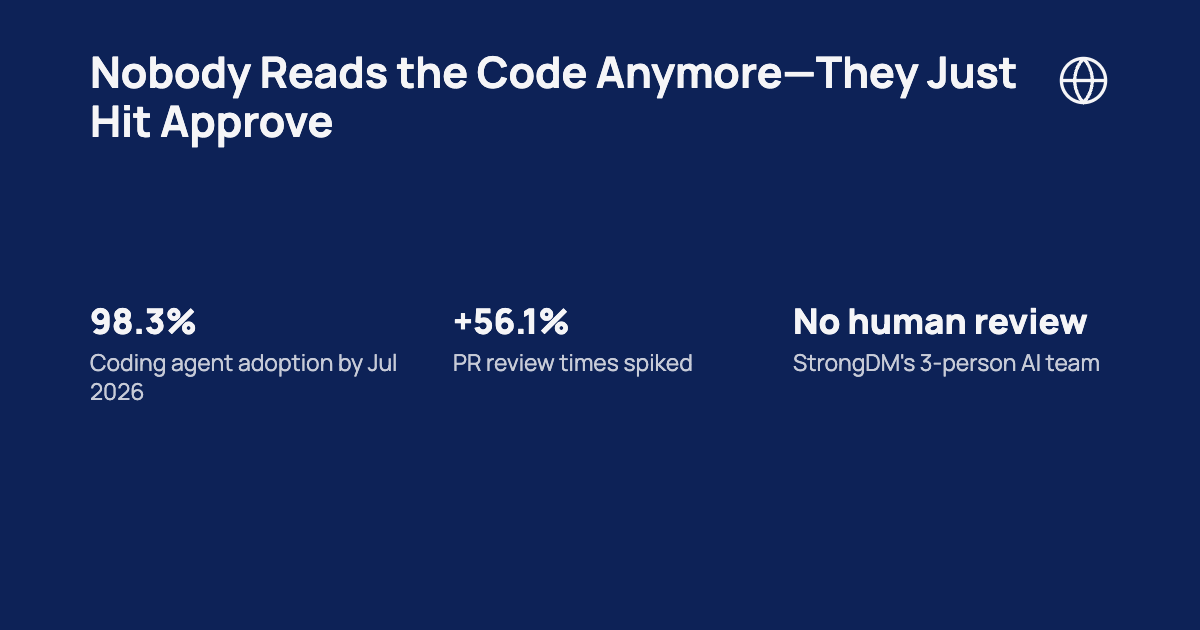
AI coding agents have become nearly universal in software development. A November 2026 study of 655 firms by Harvard and Jellyfish found that adoption reached 98.3% by July 2026. The study, by researchers Chen and Stratton, also reported that pull requests increased 35.7% and lines of code rose 44%, while resolved issues grew only 13.7% and code review times spiked 56.1%.
The figures point to a growing gap between code generation and human comprehension. Developers are approving large volumes of AI-produced code that they no longer fully understand. Research cited by Google engineering leader Addy Osmani shows that developers who delegate coding to AI score below 40% on comprehension tests of their own shipped code, versus over 65% when using AI for conceptual inquiry. The pattern has been labeled 'comprehension debt.'
The Review Illusion
The traditional gate of code review is weakened by the sheer volume of changes. Reviewers report clicking 'approve' on pull requests without reading them. Review fatigue and velocity targets encourage rubber-stamping agent-generated PRs, some exceeding 1,000 lines. Engineers often trust green CI tests rather than their own understanding. According to Margaret-Anne Storey, the phenomenon also constitutes cognitive debt, as teams struggle to keep up with the code they are responsible for.
Survey data likely understates the problem, researchers note. Developers rarely admit to skipping code reviews because it is a career risk. Instead, they quietly use AI tools to explain their own codebases after the fact. This silent delegation makes the scale of uncomprehended code difficult to measure.
Autonomous Outliers
A few firms have embraced full automation. StrongDM, a security software company, runs a three-person AI team with a strict rule that no human writes or reviews code. Agent output is verified against a simulated 'Digital Twin Universe' of Okta and Slack APIs, as documented by Simon Willison and Stanford CodeX. Spotify reported in late 2025 that its top engineers had stopped manually writing code, instead managing agent fleets that merge over 650 pull requests monthly.
These fully autonomous operations remain rare; fewer than 1% of firms run them. For most companies, the immediate risk is not replacement but unexamined acceptance. When no one understands the code that underpins supply chains, payment rails, and logistics platforms, errors become harder to trace and correct.
The consequences extend beyond software teams. Global trade, shipping, and trade finance rely on complex, interconnected systems. An unread AI-generated change in a port scheduling system or freight payment gateway could propagate through the economy before any human notices. The Harvard/Jellyfish study urges engineering leaders to adopt metrics that measure comprehension, not just output, and to create conditions where asking questions is seen as a strength rather than an admission of failure.
Subscribe
Get Niien News updates in your inbox.